|
|
|
|
Greetings,
Yay! 2020 is finally behind us! I have high hopes for 2021 and am looking forward to getting back out in the field. I'm in need of shaking off the rust!
|
|
New PC on its way!

I put together my current pc way back in 2011. At that time, it kinda rocked. It has 6 cores in a fast processor and plenty of RAM. The motherboard was fairly high-end, but not so high-end that I choked on the price. All in all, I put together a decent pc in my existing case at a fraction of the cost of a new machine from a company like Dell. This was the third or fourth (and the last) time I’d done this. Back then I sorta knew what I was doing.
But the years have gone by and my old pc is feeling it with slow boot times, some freezing up and the occasional Blue Screen of Death. Add to that, I can’t run the current version of Photoshop on it.
All this got me grumbling (in a curmudgeonly way that I think I'll adopt as I get older) that I needed a new computer. I really wasn’t looking forward to all that was involved in rebuilding a pc. The research started to overwhelm me (I don’t really keep up with the latest computer gear), and I really, really, really didn’t want to take the several days it always took me to assemble, troubleshoot (because nothing seems to work the first time) and load the operating system and programs. Then transfer needed data. Admittedly this would have giving me ample time to practice my curmudgeoning, but I'm opting for a different path.
This time I’m going with a local company that has a stellar reputation for quality systems tailored to the need of the user, and outstanding customer service. I went with Puget Systems in Auburn, WA. I’m sure some of you have heard of them and some of you may even have bought from them.
Read the thrilling conclusion on my blog........
|
|
2021 workshops and tours
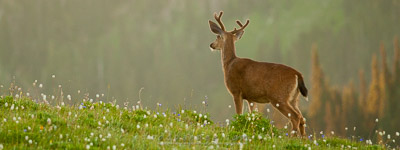
I’m working on the assumption that I’ll be able to run workshops this year. We will, of course, adhere to any Covid recommendations that may be in place, including wearing masks while indoors or when we need to interact outdoors within six feet of each other. Hopefully, many of us will have had the vaccine by then.
So with that in mind, I have openings in all of my workshops other than the first of the two Sitka tours and the second Yellowknife aurora tour. For both of those, you can get on a waiting list.
Visit my Workshops site for more information on all these trips:
- Olympic National Park: Forests, waterfalls, beaches– May 12-16
- Oregon Coast: Bandon – May 19-23
- Palouse – June 15-20
- Olympic National Park with John Barclay – July 11-18
- Sitka: Whales and more – August
- Auroras of the Northwest Territories – September
- Bosque del Apache – December 1-5
- White Sands – December 8-12
And I’m looking at some autumn trips in October too. Possibilities are Silver Falls State Park, Willamette Valley wineries, the Palouse in the fall, Newport, OR, and Zion National Park. Stay tuned.
|
|
Hyperfocal focusing revisited
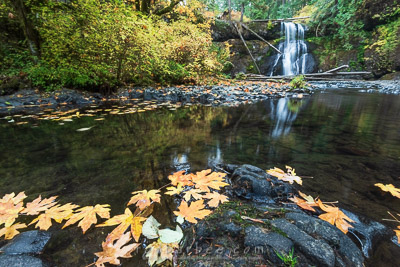
I’ve written about hyperfocal focusing before, here and here.
Briefly, hyperfocal focusing is a technique used in wide angle landscape photography to maximize the apparent focus from the closest object in the foreground to the most distant. Using a high f-stop number, like f/16 or f/22, you focus at a specific point (determined by a number of factors including focal length, f-stop, and sensor size). The depth of field for an acceptably sharp image will then extend from half that point to infinity. That “half that point” distance determines how far away you must place your camera’s focal plane from the nearest object you want to have in focus.
But what happens when you want a dynamic composition with a foreground much closer than the hyperfocal math will allow? You have two choices. Change your composition to place your foreground far enough away, or change your focus to ensure that the foreground object will be in focus.
The trade-offs are that for the first option, you don’t get the composition you had envisioned. And for second option, you run a very good chance that objects in the background will now be out of focus.
Now, with digital cameras and advances in image editing software, you can get that foreground you wanted and have the background in sharp focus. Plus you don’t have to do any math or focus your camera at a vague space in, well…space, and then place your camera at half the distance of that focus point, chant strange chants, spin three times...
No, you can use focus stacking...
...This is even more riveting than the computer story, don't you agree? You can find out what happens next on my blog....
|
|
That time of the year
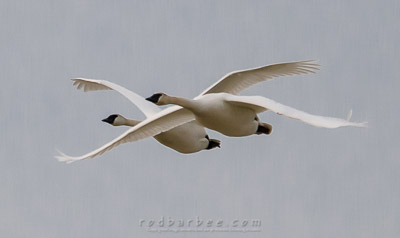
Ten years have gone by fast. I was about ten years ago to the day that I made this image of Trumpeter Swans in Mt. Vernon, WA. It was made with my old Nikon D300 fitted with a Nikon 300mm f/4 AF-S lens with a 1.4x teleconverter. I cropped it some too.
I should maybe try reprocessing this image with the new Topaz AI plug-ins for noise reduction, enlargement, and sharpening. That sounds like fun!
Until the next newsletter, everybody please stay safe and healthy!
|
|
|
|
|
|
|
|
|